Sunday, 16 October 2011

SOLAR POWER

Solar power is the conversion of sunlight into electricity, either directly using photovoltaics (PV), or indirectly using concentrated solar power (CSP). Concentrated solar power systems use lenses or mirrors and tracking systems to focus a large area of sunlight into a small beam. Photovoltaics convert light into electric current using the photoelectric effect.[1]
Commercial concentrated solar power plants were first developed in the 1980s, and the 354 MW SEGS CSP installation is the largest solar power plant in the world and is located in the Mojave Desert of California. Other large CSP plants include the Solnova Solar Power Station (150 MW) and the Andasol solar power station (100 MW), both in Spain. The 97 MW Sarnia Photovoltaic Power Plant in Canada, is the world’s largest photovoltaic plant.
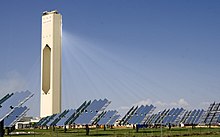
The PS10 concentrates sunlight from a field of heliostats on a central tower.

Renewable energy
Wind turbine
Biofuel
Biomass
Geothermal
Hydroelectricity
Solar energy
Tidal power
Wave power
Wind power
v · d · e

Mallard

The Mallard (play /ˈmælɑrd/ or /ˈmælərd/), or wild duck (Anas platyrhynchos), is a dabbling duck which breeds throughout the temperate and subtropical Americas, Europe, Asia, and North Africa, and has been introduced to New Zealand and Australia.
The male birds have a bright green or blue head, while the female's is light brown. The Mallard lives in wetlands, eats water plants, and is gregarious. The Mallard is the ancestor of most domestic ducks, and can interbreed with other species of genus Anas.[2] However, a potentially terminal side effect of this vast interbreeding capability is gradual genetic dilution, which is causing rarer species of ducks to become at risk for extinction.
                    
Female (left) and male (right)
Conservation status
Scientific classification e
Kingdom:Animalia
Phylum:Chordata
Class:Aves
Order:Anseriformes
Family:Anatidae
Subfamily:Anatinae
Genus:Anas
Species:A. platyrhynchos
Binomial name
Anas platyrhynchos
Linnaeus, 1758
Subspecies
Synonyms
Anas boschas Linnaeus, 1758

Saturday, 15 October 2011

HISTORY OF CHESS

The history of chess spans some 1500 years. The earliest predecessors of the game originated in India, before the 6th century AD. From India, the game spread to Persia. When the Arabs conquered Persia, chess was taken up by the Muslim world and subsequently spread to Southern Europe. In Europe, chess evolved into its current form in the 15th century. In the second half of the 19th century, modern chess tournament play began, and the first world Chess Championship was held in 1886. The 20th century saw great leaps forward in chess theory and the establishment of the World Chess Federation (FIDE). Developments in the 21st century include use of computers for analysis, which originated in the 1970s with the first programmed chess games on the market. Online gaming appeared in the mid 1990's
Chess was one of the achievments that Arab got after Muhammad Bin Qasim conquered Sindh to get Arad goverment property from Hidu and Makrani pirates. It is played on 63 board game. When british conquered SubContinent chess spread throughout the world.
                                                                       
Thrust2 is a British designed and built jet propelled car, which held the world land speed record from 4 October 1983 to 25 September 1997.
The car was designed by John Ackroyd and driven by Richard Noble. On October 4, 1983 the car reached a top speed of 650.88 mph (1,047.49 km/h) and broke the record at 633.468 mph (1,019.468 km/h) (average speed of two runs within one hour). This was achieved at the Black Rock Desert in Nevada, USA. It is powered by a single Rolls-Royce Avon jet engine sourced from an English Electric Lightning, and has a configuration somewhat resembling that of the mid-1960s-era J79 turbojet-powered land speed record cars of Art Arfons, collectively known as the "Green Monster" cars.
In 1997 Thrust2's record was broken by Richard Noble's follow up car, ThrustSSC.
When the car was offered for sale at £90,000 in 1991, an extensive fundraising campaign was organised without government assistance to keep the car in Britain. The bid was successful, and today Thrust2 and its successor, ThrustSSC, are displayed at the Coventry Transport Museum in Coventry, England.